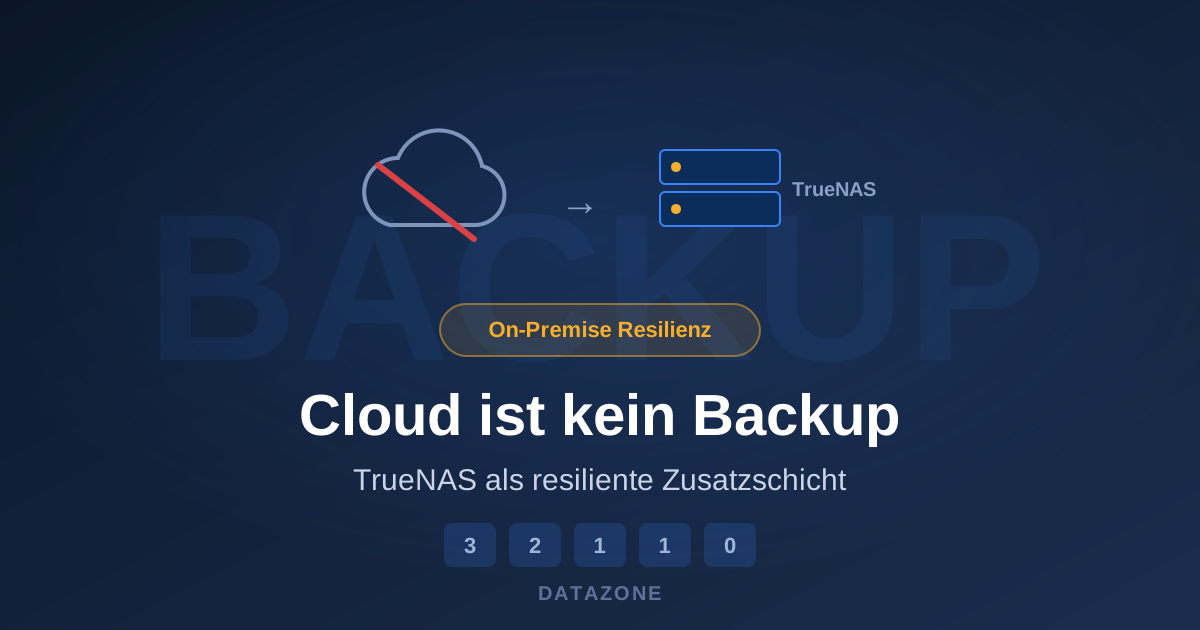
In mid-September 2026, a report shook a lot of cloud strategies: Amazon Web Services announced it was unable to recover data from several destroyed data centers. According to reports, all three availability zones in the Bahrain region plus one zone in the United Arab Emirates were affected — damaged by wartime events in the region. The official recommendation to affected customers: fall back on your own backups.
That is the moment an uncomfortable truth becomes visible — one that sits in every hyperscaler’s fine print: the cloud is not a backup. And this is precisely where an on-premises layer built on TrueNAS earns its keep — not as a cloud replacement, but as the layer that remains when everything else fails.
Why “cloud” and “backup” are not the same thing
Hyperscalers operate on a shared responsibility model. In short: the provider ensures the availability of the infrastructure — you are responsible for your data. The cloud does not reliably protect you against:
- Ransomware and compromise — encrypted or deleted objects get dutifully replicated across all regions.
- Accidental or malicious deletion — one wrong command, one compromised admin account, and the data is gone.
- Region- or provider-wide outage — fire, war, natural disaster, insolvency, or a suspended account ID.
- Geopolitical risk — sanctions, jurisdictions, a physical location outside your control.
- Cost explosion — restoring from the cloud often means massive egress fees exactly when things are on fire.
Cloud-native “backups” almost always live with the same provider, in the same trust boundary. If the provider fails or the account is compromised, the backup is affected too. A backup that can die together with the original is not a backup.
The 3-2-1-1-0 rule — and where on-premises sits
The proven rule of thumb for resilient data protection is now 3-2-1-1-0:
- 3 copies of the data,
- on 2 different media/systems,
- 1 of them off-site,
- 1 of them offline or immutable (air-gapped),
- 0 errors on restore (tested restores).
A pure cloud strategy usually does not satisfy this rule — it lacks the independent, controllable copy outside the provider’s trust boundary. That is exactly the role of an on-premises TrueNAS: the one copy you physically own, whose location you know, and whose restore costs nothing but your own bandwidth.
Why TrueNAS is the ideal on-premises layer
TrueNAS brings exactly the properties that make a backup layer resilient:
Immutable ZFS snapshots
ZFS snapshots are created in seconds thanks to copy-on-write, with no initial extra storage. With snapshot retention and immutability, recovery points can be protected so that even an administrator cannot delete them within the retention window — the decisive brake against ransomware. More: Benefits of TrueNAS snapshots.
Pull-based replication instead of push
The most important architectural trick: the backup system pulls the data from production (pull), instead of production writing to the backup (push). A compromised production system therefore has no credentials and no write access to the backup target. Ransomware that encrypts production simply cannot reach the backup.
Real air-gap
A dedicated, isolated backup network — or a target that is only reachable during replication windows — creates a virtual air-gap: a replication path kept separate from day-to-day network access, so an attacker who owns production still cannot touch the backup.
Checksums & self-healing
ZFS verifies every block against a checksum and automatically repairs bit-rot from redundancy. A backup that silently rots is worthless — TrueNAS detects and heals such damage on the fly.
Data sovereignty & cost
You know the physical location of your data (relevant for GDPR), you are not locked into any provider, and you pay no egress fees on restore. The hardware is yours — a one-time investment instead of an open-ended monthly bill.
A proven architecture
A typical, resilient setup looks like this:
- Production data — local (e.g., a Proxmox cluster, file servers) or in the cloud.
- On-premises TrueNAS as the backup target — pulls snapshots from production. Immutable retention prevents deletion within the retention window.
- Off-site copy — a second TrueNAS at another location, fed via encrypted ZFS replication — the external, air-gapped copy.
# Pull replication: the BACKUP system fetches the snapshot from the production NAS.
# The production system has NO access to the backup target.
zfs send -I tank/data@yesterday tank/data@today \
  | ssh prod-nas "zfs recv -Fv backup-pool/data"
Even if production — whether a cloud region or a local cluster — is lost entirely: the on-premises layer stands, it is tested, and the restore runs over your own line.
What this protects against
| Scenario | Cloud alone | + On-premises TrueNAS |
|---|---|---|
| Ransomware in production | backup often encrypted too | pull + immutable → unreachable |
| Accidental deletion | depends on versioning | snapshot restore in minutes |
| Region/provider outage | total loss possible | independent copy remains |
| War / physical destruction | as in the AWS case | off-site copy at your location |
| Restore cost | high egress fees | own bandwidth, €0 egress |
| Account lockout / insolvency | no data access | full control |
Conclusion
The cloud is an excellent tool — but it is not a backup, and even the largest provider in the world tells customers, when it matters: use your own backups. An on-premises layer with TrueNAS is the most pragmatic, cost-effective and resilient way to build exactly that copy — with immutable snapshots, pull replication and a real air-gap.
As an authorized TrueNAS reseller in Germany, we plan your backup layer to fit your workload. Build your system in the TrueNAS configurator or get in touch for a no-obligation quote.
More on these topics:
More articles
On-Premises vs. Cloud: Where Local TrueNAS Storage Beats the Cloud
The cloud is not always the best choice. Where on-premises storage with TrueNAS wins on cost, data sovereignty, performance, control and resilience — and when hybrid is the smartest answer.
TrueNAS for Medical Practices and MVZ: KBV-Compliant Storage Without the Cloud
TrueNAS for medical practices and MVZ: KBV-compliant storage, encryption at rest, audit logging and SMB access for Medistar or Turbomed. GDPR Art. 9 covered.
TrueNAS Proxmox Plugin exits pre-announcement: early-adopter rollout with signed APT repo
iXsystems has moved the TrueNAS storage plugin for Proxmox VE from pre-announcement to a concrete early-adopter rollout — signed APT packages for Bookworm and Trixie, a cluster-aware installer, multi-tenancy against a single TrueNAS, and official early-adopter status. What is new, what it means in practice, and where the limits are.