TrueNAS F-Series
All-NVMe high-performance storage. 2U dual-controller, up to 30 GB/s, Fibre Channel and 100 GbE.
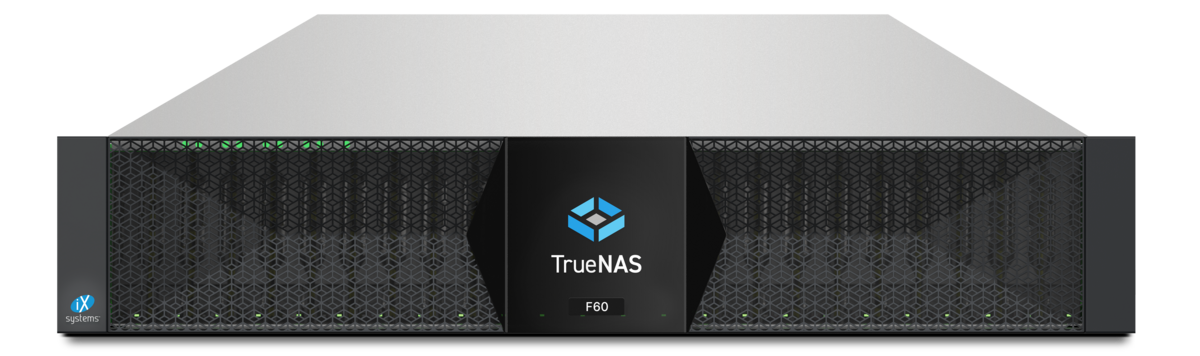
F-Series: All-NVMe High-Performance Storage
The TrueNAS F-Series condenses enterprise storage into 2 rack units: 24 Gen4 NVMe bays, dual-controller HA and up to 30 GB/s throughput from a single chassis. Where HDD-based systems hit their latency ceiling, the F-Series delivers consistently low response times — even under very high concurrency.
Available as the F60 for classic all-flash workloads and as the performance flagship F100 with 48 cores per controller, double the network capacity and up to 20 PB raw all-flash capacity. Both models use the full TrueNAS Enterprise suite — inline compression, fast deduplication, NVMe-oF, Fibre Channel and automated HA failover.
Two models — one platform
Pick the F model that fits your workload — both share the same TrueNAS Enterprise suite and the same 2U footprint.
All-flash all-rounder
Consolidated all-NVMe system for virtualisation, databases and media. Full HA options and 100 GbE connectivity in 2U.
- • 32 cores / 64 threads per controller
- • 512 GB DRAM read cache
- • Up to 10 PB all-flash
- • 20 GB/s throughput
- • 4× 100 GbE + 4× 32 Gb FC
Highest performance
Maximum throughput and scale in 2U. Built for AI/ML training, hyperscale virtualisation and 8K media workflows.
- • 48 cores / 96 threads per controller
- • 512 GB DRAM read cache
- • Up to 20 PB all-flash
- • 30 GB/s throughput
- • Up to 8× 100 GbE + 6× 32 Gb FC
Configure the F-Series yourself
Build your live capacity, RAID layout, networking and expansion in a few clicks — shareable config code, no login, free of charge.
Open the configuratorTrueNAS F-Series: Capacity & Sizing
How much usable capacity remains after RAID parity and ZFS overhead? Typical F-Series configurations as a guide — the exact figures for your drive layout are calculated live in the configurator.
24× 15,36 TB NVMe, RAIDZ2 (2× 12-wide)
Performance entry point to the F-series.
Calculate with your own values24× 30,72 TB NVMe, RAIDZ2 (2× 12-wide)
48 cores, 6× 100 GbE — for AI/DB with high IOPS.
Calculate with your own values24× 30,72 TB + 2× ES24N (24× 30,72 TB), RAIDZ2 (6× 12-wide)
Scaled all-flash platform for AI/HPC workloads.
Calculate with your own valuesGuide values (TB = 10¹² bytes). Actual usable capacity depends on vdev layout, RAID level, pool fill and data type. Values include ZFS RAIDZ padding at 128 KiB recordsize / ashift=12 (iX-quote-conform).
Configure your own F-SeriesTrueNAS F-Series: Detailed specifications
Per-model comparison — generated directly from the configurator model data (single source of truth).
| Specification | F60 | F100 |
|---|---|---|
| Form factor | 2U (686 mm Tiefe) | 2U (686 mm Tiefe) |
| High availability (HA) | Optional | Optional |
| Storage modes | All-flash / Hybrid | All-flash / Hybrid |
| CPU (cores / threads) | 32 Cores / 64 Threads | 48 Cores / 96 Threads |
| RAM (max.) | 128–512 GB | 256–512 GB |
| Drive bays | 24× NVMe-U.2 (front) | 24× NVMe-U.2 (front) |
| Read cache | 512 GB DRAM Read Cache | 512 GB DRAM Read Cache |
| Write cache | Distributed Write Log | Distributed Write Log |
| Max capacity (raw) | 10 PB | 20 PB |
| Max. drives | 72 | 168 |
| Max throughput | 20 GB/s | 30 GB/s |
| Fibre Channel | 4× 32Gb | 6× 32Gb |
| Network (max.) | Bis 4× 10/25/40/100 GbE | Bis 4× 10/25/40/100 GbE (optisch) · Alternativ bis 8× 100 GbE (Datasheet Feb 2026) · 2× 10GBase-T |
| Management | 1× IPMI + 1× WebUI Management | 1× IPMI + 1× WebUI Management |
| Expansion shelves | 2× ES24N | 4× ES24 | 4× ES60 | 4× ES102 (max 4 gesamt) | 6× ES24N | 8× ES24 | 8× ES60 | 8× ES102 (max 8 gesamt) |
| Power (typ.) | 420 W | 560 W |
| Power (peak, HA) | 996 W | 1152 W |
| Heat output (HA) | 3,398 BTU/h | 3,931 BTU/h |
| Input voltage | 200–240 V (high-line) | 200–240 V (high-line) |
| Redundant PSU | Yes | Yes |
| Dimensions (L×W×H) | 686 × 483 × 89 mm | 686 × 483 × 89 mm |
| Weight | 19.5 kg empty / 25.4 kg full | 19.5 kg empty / 25.4 kg full |
| Operating temperature | 5–35 °C | 5–35 °C |
| Humidity | 20–80 % | 20–80 % |
| Certifications | RoHS 6/6, CE, FCC Class A, UL, TÜV, BSMI, KC, VCC | RoHS 6/6, CE, FCC Class A, UL, TÜV, BSMI, KC, VCC |
Architecture and expansion
The 2U chassis combines 24 Gen4 NVMe bays with two AMD EPYC controllers and scales through NVMe and SAS shelves.
24 NVMe Gen4 drive bays
Front-loading 2.5" hot-swap slots, all wired as Gen4 NVMe. Drives from 3.8 TB to 122 TB yield up to 20 PB raw in a 2U chassis.
Dual-controller HA
Two AMD EPYC controllers (32 or 48 cores) with active/standby failover, virtual IP migration and zero data loss on switchover.
Distributed Write Log
Write log distributed across multiple NVMe drives instead of a classic SLOG — lower sync-write latency and no dedicated cache devices required.
NVMe + hybrid expansion
Scale with ES24N NVMe shelves (up to 6× on F100) or SAS shelves for hybrid pools — 4× 6.4 TB NVMe read cache in front of the HDD tier.
Available storage media
All media ship with full TrueNAS Enterprise integration — including hardware AES-NI encryption, S.M.A.R.T. monitoring and hot-swap support.
NVMe Gen4 SSDs (front bays)
- • 3.8 TB to 122 TB per SSD
- • 2.5" U.2/U.3 hot-swap
- • Optional SED and FIPS 140
- • Up to 20 PB raw in a 2U chassis
Hybrid tier: SAS3 HDDs (expansion shelves)
- • 7200 RPM Enterprise Nearline
- • 8 TB to 26 TB per drive
- • 4× 6.4 TB NVMe read cache in front
- • Optional SED and FIPS 140
Power, climate, dimensions
Redundant hot-swap power supplies, out-of-band management via IPMI and UPS signal integration are standard. The 2U format enables high rack density at under 1.2 kW peak load.
Protocols and integration
Full TrueNAS Enterprise suite — file, block and object in one system. Deep integration into hypervisor and cloud stacks.
File protocols
- • SMB v1/2/3
- • NFSv3, NFSv4 with RDMA
- • FTP, WebShare
Block protocols
- • iSCSI, RDMA via iSER
- • NVMe-oF (TCP/RDMA)
- • Fibre Channel (32 Gb)
- • OpenStack Cinder
Object & directory services
- • S3-compliant + Immutable Locking
- • MinIO Alstor
- • Active Directory, FreeIPA
- • Kerberos, LDAP, NIS
Hypervisors & apps
- • VMware (VAAI, vCenter, VM Warn/Stun)
- • Proxmox plugin (iSCSI + snapshots)
- • Hyper-V (VSS, ODX, CSV)
- • KVM, XenServer, OpenShift
- • Kubernetes CSI
What is the F-Series built for?
Latency-critical all-NVMe workloads that demand low response times under high concurrency.
AI/ML training
High read rates for GPU clusters, NVMe-oF for a direct path to compute nodes, consistent latency for iterative training runs.
Containers & cloud-native
Kubernetes CSI with snapshots and clone ops, persistent volumes for stateful workloads, S3 backend for object stores.
Media production (4K/8K)
Multiple parallel 8K editing streams from all-NVMe, with consistently low latency and high bandwidth over 100 GbE.
High-performance databases
SAP HANA, Oracle, large SQL clusters and in-memory workloads with low sync-write latency thanks to the Distributed Write Log.
Virtualisation at scale
Consolidated storage for VMware, Proxmox, Hyper-V and Kubernetes — high tenant density and transparent HA failover.
Content delivery & streaming
Edge and origin storage for video and asset delivery — high random-read performance and 100 GbE connectivity.
Security and compliance
The F-Series uses the TrueSecure features of the TrueNAS Enterprise suite — from hardware-accelerated encryption to audited admin roles.
Backup and cloud integration
The F-Series fits seamlessly into existing backup and cloud strategies — as primary performance tier as well as replication target or source.
Your benefits with DATAZONE
As a TrueNAS partner we accompany you through the complete F-Series lifecycle — from sizing and commissioning to operations. We are vendor-neutral and configure the system strictly around your real requirements.
Is the F-Series right for your project?
The F-Series is the right choice if at least one of these applies:
- → You need pure all-NVMe performance, no HDD tier
- → Consistently low latency under high concurrency required
- → High rack density needed — 2U instead of 4U
- → AI/ML, database or 4K/8K media workflows
- → Connecting to an existing FC SAN
If you need >100 GbE or tri-mode (HDD+NVMe in one chassis), the V-Series fits better. Pure HDD capacity is served more economically by the M or R-Series.
Frequently asked questions
What is the TrueNAS F-Series?
Which models are part of the F-Series?
What is the difference between F60 and F100?
Does the F-Series support high availability?
Which expansion shelves are compatible?
What networking and FC options are available?
Which protocols and hypervisors are supported?
When is the F-Series the right choice — and when V, M or R-Series?
Evaluate TrueNAS F60 or F100
We advise you on the right configuration (F60 vs. F100, all-flash vs. hybrid), network and FC design and migration from existing storage infrastructure.
Get in touch