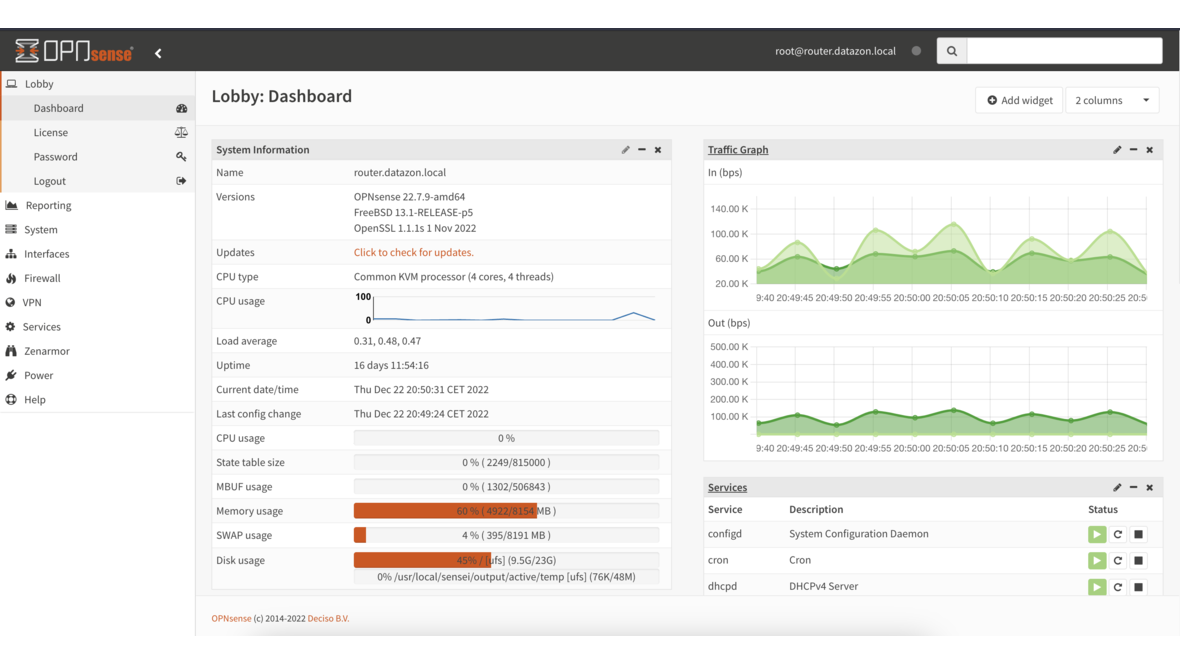
OPNsense 21.7, codenamed “Noble Nightingale”, has been released and brings significant improvements to the open-source firewall. This release is based on FreeBSD 13 for the first time and delivers numerous new features.
Release Highlights
FreeBSD 13 as the Base
The switch to FreeBSD 13 is the most important change in this release:
- Updated network stack with improved performance
- Better hardware support
- Updated cryptography libraries
- Optimized memory management
WireGuard Kernel Module
OPNsense 21.7 integrates a native WireGuard kernel module:
- Significantly better performance compared to the previous userspace implementation
- Easier configuration via the web interface
- Stable operation for site-to-site and road warrior VPN
- Support for multiple tunnels simultaneously
Improved Firmware Update System
The update system has been fundamentally redesigned:
- Faster and more reliable updates
- Better error handling for update issues
- Easy rollback capability
- Improved progress display
Firewall Improvements
- Redesigned alias management
- Improved GeoIP filtering
- Optimized rule processing
- Extended logging capabilities
IPsec Updates
- Updated strongSwan VPN stack
- Improved IKEv2 support
- Extended cipher options
- Optimized tunnel management
Web Interface
The user interface received various improvements:
- Modernized dashboard
- Faster page loading times
- Improved firmware status widget
- Extended diagnostics tools
Security Updates
- Updated OpenSSL
- Suricata IDS/IPS updates
- Unbound DNS resolver update
- Numerous CVE fixes
Migration from 21.1
The upgrade from OPNsense 21.1 to 21.7 can be performed via the web interface under System > Firmware. A prior backup of the configuration is strongly recommended.
Conclusion
OPNsense 21.7 is an important release that brings significant performance improvements with FreeBSD 13 as the base and the native WireGuard kernel module. As an experienced OPNsense integrator, we are happy to advise you on planning and implementing your firewall infrastructure.
More on these topics:
More articles
TrueNAS as an Immutable Backup Target for Veeam & Proxmox (S3 Object Lock)
Immutable backups against ransomware: how to use TrueNAS as an S3-compatible immutable target with Object Lock for Veeam and Proxmox Backup Server — on-premises, without cloud egress.
OPNsense Hardware Buying Guide 2026: From Home Office to HA Cluster
How to size OPNsense hardware in 2026: classes for 50/250/1000 users, 2.5/10/25/40 GbE ports, IDS throughput framing, coldspare vs. HA and procurement.
Firewall for small businesses 2026: the honest comparison
Firewall for small businesses 2026 compared: FritzBox, OPNsense, pfSense Plus, Sophos XGS and Fortinet FortiGate -- what fits for 5 to 50 users?