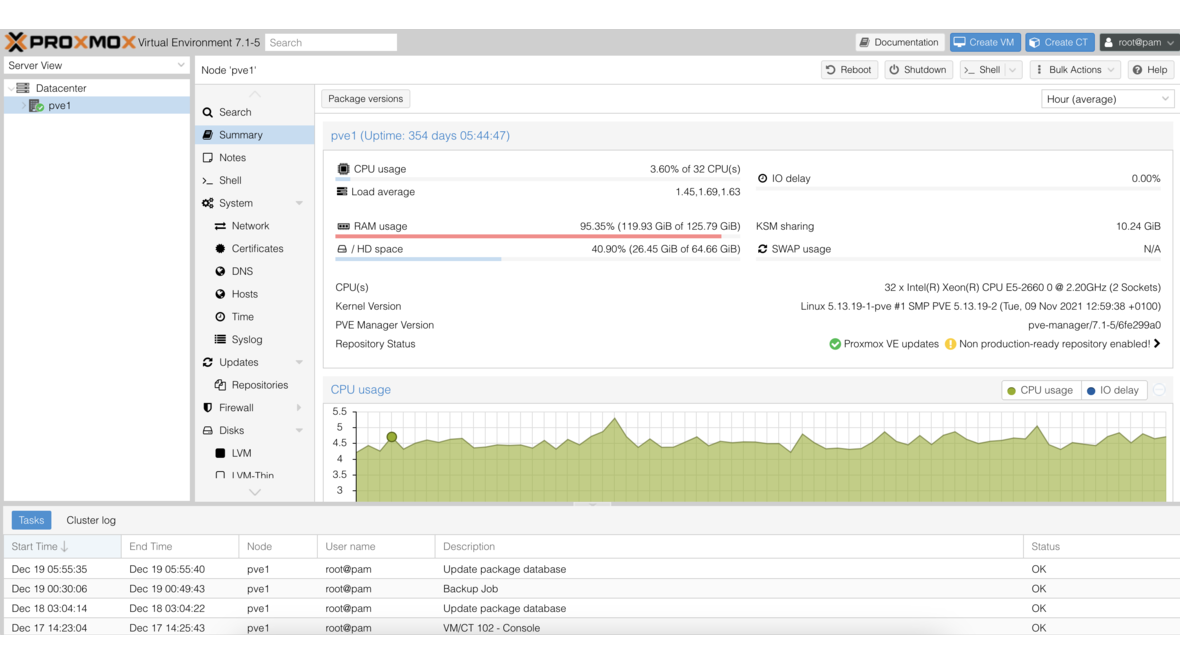
Proxmox Virtual Environment 6.4 has been released and is the last planned point release of the 6.x series. It brings important updates and stability improvements.
Key New Features
Kernel and QEMU
- Updated Linux Kernel 5.4 LTS with the latest security patches
- QEMU 5.2 with new features and bugfixes
- Improved virtio drivers
- Optimized live migration
- Updated CPU models
Ceph Improvements
- Ceph Octopus 15.2 as default
- Improved Ceph dashboard integration
- Optimized OSD management
- Extended monitoring functions
- Improved pool management and Crush Map editor
ZFS Updates
- ZFS 2.0 support with numerous improvements
- Improved Persistent L2ARC
- Optimized Sequential Resilvering
- Extended encryption options
- Performance improvements
Proxmox Backup Server Integration
The integration with the Proxmox Backup Server (PBS) has been further improved:
- Optimized backup speed
- Improved Single-File Restore
- Extended scheduling options
- Better status overview
- Improved bandwidth management
Web Interface
- Improved Resource Tree with grouping
- Extended tag support for VMs and containers
- Optimized network configuration
- Improved storage overview
- Extended user and permission management
- Dark theme improvements
SDN (Software Defined Networking)
- Extended VXLAN support
- Improved zone configuration
- Optimized VNet management
- EVPN improvements
Container Improvements
- Updated LXC 4.0
- Improved container templates
- Optimized container migration
- Extended resource management
Upgrade
The upgrade from Proxmox VE 6.3 to 6.4 is performed via the regular package repositories:
apt update
apt dist-upgrade
A reboot is recommended for the updated kernel.
Outlook on Proxmox VE 7.0
Proxmox VE 6.4 is the final release of the 6.x series. The next major version, Proxmox VE 7.0, will be based on Debian 11 “Bullseye” and will bring further significant innovations.
Conclusion
Proxmox VE 6.4 rounds off the 6.x series with a stable and feature-rich release. The improved PBS integration and ZFS 2.0 support demonstrate the continuous development of the platform. As a certified Proxmox partner, we are happy to advise you on the upgrade path to Proxmox VE 7.0.
More on these topics:
More articles
TrueNAS as an Immutable Backup Target for Veeam & Proxmox (S3 Object Lock)
Immutable backups against ransomware: how to use TrueNAS as an S3-compatible immutable target with Object Lock for Veeam and Proxmox Backup Server — on-premises, without cloud egress.
TrueNAS Proxmox plugin 25.10.6: four observations from our test lab, fed back to iXsystems as a partner
Early adoption means helping to shape. We run the official TrueNAS storage plugin for Proxmox VE productively and document here what we observed in version 2.1.17+deb1 on PVE 9.2.11 and TrueNAS SCALE 25.10.6 — including workarounds for the community and a note on how we fed it back to iXsystems.
Proxmox vs. VMware vSphere 8 -- 2026 update: the state of play after two years of Broadcom
Proxmox vs VMware 2026 -- an honest comparison against vSphere 8 after two years of Broadcom. Where Proxmox has caught up, where vSphere still leads. From the trenches.