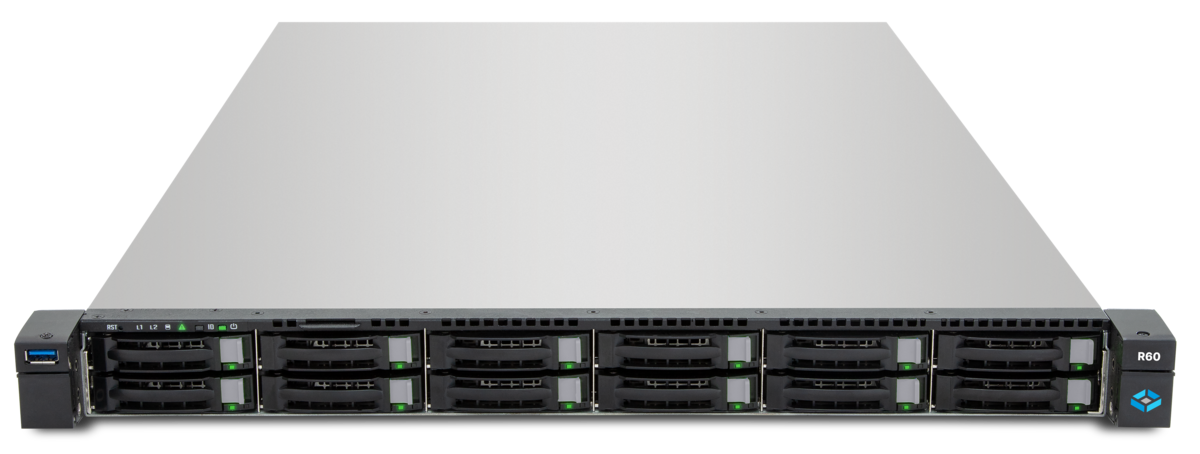
TrueNAS comes in two editions: TrueNAS CORE and TrueNAS SCALE. Both are built on OpenZFS and deliver enterprise-grade storage capabilities — but under the hood, they are fundamentally different. CORE runs on FreeBSD and has proven itself as a reliable storage platform over many years. SCALE is built on Linux (Debian) and brings modern features such as Docker, Kubernetes, and scale-out clustering.
Since 2023, iXsystems has shifted active development to TrueNAS SCALE. CORE continues to receive maintenance and security updates but no new features. For businesses, this raises an important question: which edition is the right choice?
Feature Comparison: TrueNAS CORE vs TrueNAS SCALE
| Criterion | TrueNAS CORE | TrueNAS SCALE |
|---|---|---|
| Operating System | FreeBSD | Linux (Debian-based) |
| File System | OpenZFS (native) | OpenZFS (native) |
| Storage Architecture | Scale-Up (single system) | Scale-Up + Scale-Out (cluster via Gluster) |
| Virtualization | bhyve VMs | KVM VMs |
| Containers / Apps | Plugins (FreeBSD Jails) | Apps (Docker / Kubernetes) |
| SMB / NFS / iSCSI | Fully supported | Fully supported |
| Active Directory | Supported | Better integration (Linux-based) |
| Replication | ZFS Send/Receive | ZFS Send/Receive |
| High Availability | Enterprise only | Enterprise only |
| GPU Passthrough | Limited | Full support (KVM + NVIDIA/AMD) |
| Hardware Compatibility | FreeBSD drivers (limited) | Linux drivers (broader support) |
| Development Status | Maintenance mode | Actively developed |
| Community | Established, stable | Growing rapidly |
Both Editions in Detail
TrueNAS CORE served as the standard platform for ZFS-based storage for over a decade. The FreeBSD foundation provides excellent network performance and a mature jail system for running applications. Many businesses have been running CORE reliably in production environments for years.
TrueNAS SCALE was released as a stable version in 2022 and has evolved rapidly since then. The Linux foundation brings significant advantages: broader hardware support through the vast Linux driver ecosystem, native Docker and Kubernetes integration for modern applications, and the ability to connect storage across multiple nodes in a cluster.
When Should You Choose TrueNAS CORE?
TrueNAS CORE remains the right choice in certain scenarios:
- Existing FreeBSD deployments — If you are already running CORE in production and do not need new features, there is no reason to switch immediately. Your system is stable and continues to receive security updates.
- FreeBSD Jails — If you are running existing plugins and jails that cannot easily be migrated to Docker containers.
- bhyve virtualization — If you rely on bhyve VMs and do not plan to migrate to KVM.
- Proven stability — CORE has matured over many years. If you prefer a conservative, time-tested platform, CORE provides a solid foundation.
Keep in mind, however, that CORE no longer receives new features. In the long term, SCALE is the platform that iXsystems is investing in.
When Should You Choose TrueNAS SCALE?
For most new deployments, TrueNAS SCALE is the recommended choice:
- New installations — If you are deploying TrueNAS for the first time, start with SCALE. You benefit from active development and all the latest features.
- Docker and Kubernetes — SCALE supports Docker containers and Kubernetes apps natively. The app ecosystem is significantly larger and more modern than the legacy FreeBSD plugin system.
- Better hardware compatibility — Linux drivers cover a much broader range of hardware. Newer network cards, HBAs, and storage controllers are often supported under Linux sooner.
- Scale-out storage — With Gluster-based clustering, you can distribute storage across multiple TrueNAS nodes. Ideal for growing environments that need to scale beyond a single system.
- Active Directory — The Linux-based AD integration in SCALE is more robust and offers better compatibility with modern AD environments.
- GPU passthrough for AI/ML — SCALE provides full GPU passthrough via KVM. Ideal for workloads using NVIDIA or AMD GPUs for artificial intelligence and machine learning.
- Future-proofing — SCALE is the platform that iXsystems is actively investing in. New features, performance improvements, and security updates are released for SCALE first.
Migrating from CORE to SCALE
iXsystems provides an official migration path from TrueNAS CORE to SCALE. Here are the key points:
- ZFS pools are compatible — Your existing ZFS pools are recognized by SCALE and can be imported. Your data remains intact.
- Configuration export — CORE offers a config export that helps transfer settings to SCALE.
- Plugins to Docker — FreeBSD jails and plugins must be replaced with Docker containers. For most applications, equivalent Docker images are available.
- VMs — bhyve VMs cannot be directly imported into KVM. A reinstallation of VMs or disk conversion is required.
Our recommendation: Perform the migration in a test environment first. Export your CORE configuration, install SCALE on separate hardware, and import your pools. Once everything works as expected, you can plan the production cutover.
For complex environments, we recommend professional guidance. DATAZONE supports you with planning, execution, and validation of the migration.
DATAZONE Recommendation
As a TrueNAS partner, we advise businesses daily on choosing the right storage platform. Our clear recommendation:
For new deployments, we recommend TrueNAS SCALE. The Linux foundation offers better hardware compatibility, the Docker ecosystem outperforms the legacy plugin system, and active development by iXsystems ensures long-term support and innovation.
TrueNAS CORE remains a solid platform for existing, stable installations. If your system runs reliably and you do not need new features, there is no immediate pressure to change. However, plan for a migration to SCALE in the medium term to benefit from ongoing development.
Regardless of edition: TrueNAS provides a data protection foundation built on ZFS that surpasses proprietary alternatives in terms of data integrity and flexibility.
Frequently Asked Questions
What is the main difference between TrueNAS CORE and SCALE?
CORE is based on FreeBSD, SCALE on Linux (Debian). SCALE offers Docker/Kubernetes apps, KVM virtualization, and scale-out clustering. CORE uses FreeBSD jails and bhyve VMs.
Is TrueNAS SCALE more stable than CORE?
Both editions are production-ready. CORE has the advantage of a longer maturation period, while SCALE is actively developed and gains stability with every release. For new installations, SCALE is the recommended platform.
Can I migrate from TrueNAS CORE to SCALE?
Yes, iXsystems provides an official migration path. ZFS pools are compatible. Plugins (jails) must be replaced with Docker containers. We recommend performing a test migration first.
Is TrueNAS CORE being discontinued?
CORE is in maintenance mode and continues to receive security updates. However, new features are developed exclusively for SCALE. In the long term, SCALE is the future of TrueNAS.
Which edition is better for businesses?
For new enterprise installations, we recommend TrueNAS SCALE. The broader hardware compatibility, Docker integration, and active development make SCALE the future-proof choice.
Planning a TrueNAS project or migrating from CORE to SCALE? Contact us — we provide no-obligation consulting and support through the entire process.
More on these topics:
More articles
IT in the Trades: How a 50-Employee SMB Runs Proxmox and TrueNAS in Production
Anonymised reference case: a mid-sized trades business with 50 employees, project drawings, DATEV accounting and mobile site managers on Proxmox and TrueNAS.
TrueNAS SMB Security: AES-128/256, SMB3 Signing, and What Admins in SMB Shops Should Change Now
TrueNAS SMB security done right: disable SMB1, enforce SMB3 signing, enable AES-128/256-GCM, and keep clean audit logs — a practical guide for small and midsize shops.
TrueNAS Mini R for the home office: real enterprise storage for branch sites and remote teams
TrueNAS Mini R for home office and branch sites: 2U rackmount with ECC, 10 GbE, ZFS replication back to HQ and TrueCloud. Buyer's guide for edge storage and remote teams.