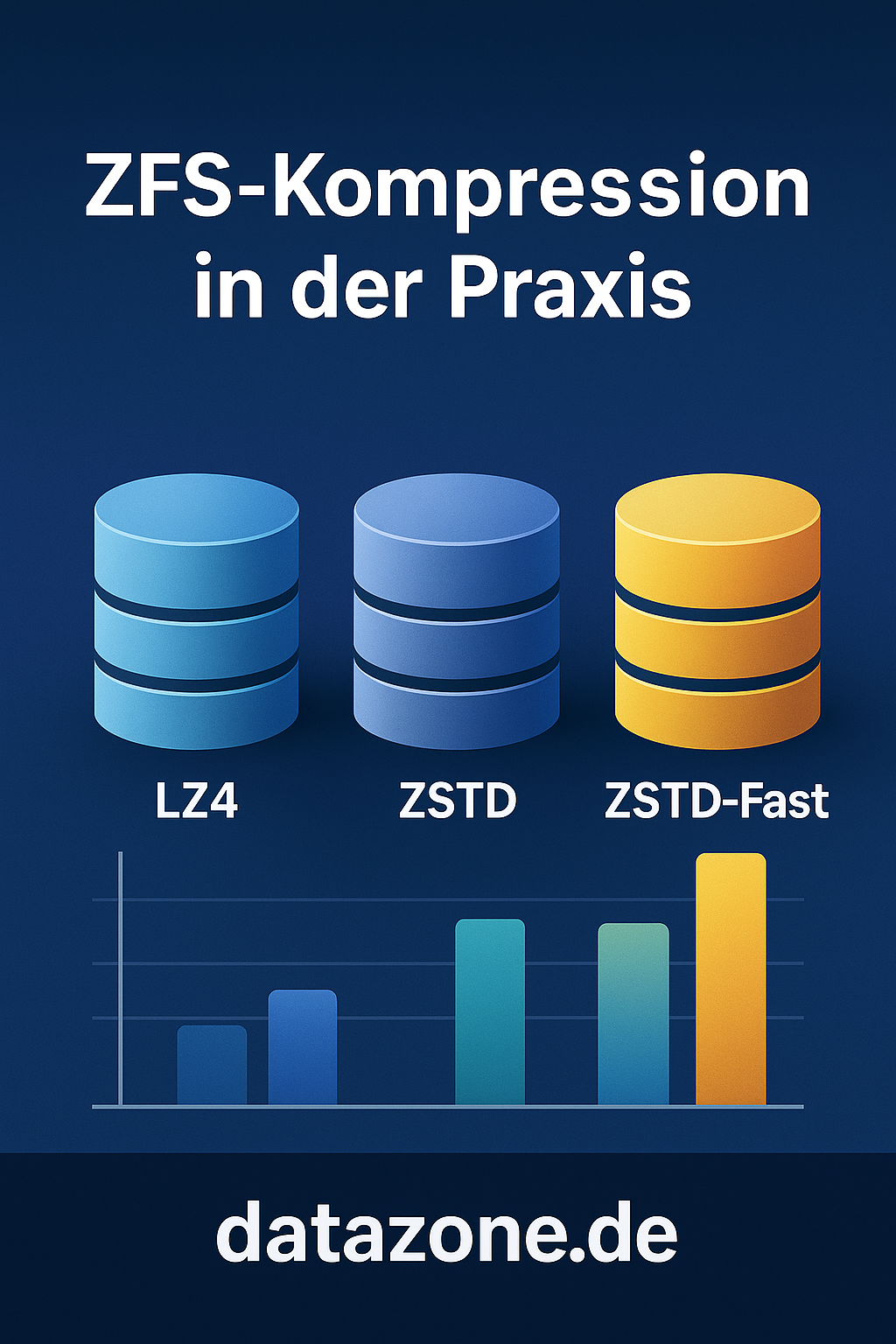
Choosing the right compression method in ZFS is no longer just about storage consumption — it determines performance, latency, I/O optimisation, and replication efficiency. With NVMe, modern multi-core CPUs, and higher data rates, compression plays a far greater role than it did just a few years ago. The old reflex of “compression makes everything slower” is long outdated — in fact, it is one of the most important performance factors for TrueNAS systems.
This article examines the three relevant compression methods — LZ4, ZSTD, and ZSTD-Fast — from the perspective of workload profiles, CPU characteristics, deduplication effects, backup strategies, and real-world examples from data centre environments.
ZFS and Compression: Why This Is a Performance Topic Today
Traditionally, compression was about reducing storage space. In modern ZFS environments, however, a different paradigm applies:
Compression replaces expensive I/O with inexpensive CPU cycles.
This effect increases with faster storage media:
-
HDD —> little effect
-
SAS SSD —> good effect
-
NVMe —> dramatic effect
Because NVMe is so fast, I/O avoidance becomes the central performance booster. Every reduction in physical write volume extends SSD lifespan and lowers latency.
ZFS compresses before writing. This means:
-
less data is written
-
less data needs to be replicated
-
less data resides in the ARC
-
snapshots become more efficient
-
backup cycles are shortened
Compression is therefore not cosmetic — it is a performance component.
LZ4 — The “Gold Standard” for Universal Performance
LZ4 is the default in ZFS — and for good reason. It is one of the fastest compression algorithms in the industry and an ideal balance of speed and storage system relief.
Technical Characteristics
-
extremely low CPU overhead
-
very fast (de)compression
-
predictable performance, even under heavy load
-
ideal for VMs, databases, containers, apps, web servers
For Decision-Makers
LZ4 increases performance, extends storage media lifespan, and reduces replication time — without additional hardware costs.
For Administrators
LZ4 is the right choice when workloads are heterogeneous and low latency is more critical than storage optimisation.
ZSTD — Compression for Capacity, Archival, and Large Data Reduction
ZSTD is a modern, efficient compressor for files, archival data, container layers, logs, and backups. It achieves significantly better compression ratios than LZ4 but comes with a measurable CPU cost, particularly during writes.
Typical Use Cases
-
Backups expecting 30—70 % savings
-
Archival data, software images, container layers
-
Log-intensive workloads (syslog, Elastic, telemetry)
-
Project shares with many similar files
Relevance for Decision-Makers
ZSTD is suitable for organisations with high long-term retention requirements or expensive storage tier costs.
Administrator Perspective
ZSTD can slow down NVMe systems when CPU resources are scarce. It should therefore be used deliberately:
-
for sequential workloads
-
when latency requirements are low
-
on CPU-rich systems
ZSTD-Fast — The Modern Compromise
ZSTD-Fast is the evolution of the ZSTD algorithm for situations where CPU costs should remain low but significant capacity benefits are still desired.
It is the new favourite for backup systems.
Technical Profile
-
CPU costs significantly lower than ZSTD
-
Compression ratio significantly higher than LZ4
-
Ideal for backup, PBS, snapshots, archiving
-
Particularly effective on SAS SSD and NVMe
Real-World Observations
In real TrueNAS installations, savings between 35 and 55 % are achieved — with barely noticeable CPU load.
Practical Comparison
| Criterion | LZ4 | ZSTD | ZSTD-Fast |
|---|---|---|---|
| CPU load | very low | high | low—moderate |
| Compression ratio | low—moderate | high—very high | moderate—high |
| I/O reduction | good | very good | very good |
| Ideal for | VM, DB, apps | archive/backup | backup + file |
| Replication | fast | faster | very fast |
| NVMe effect | very good | good | very good |
Recommendations by Workload Profile
Virtualisation (Proxmox VE, VMware, KVM)
—> LZ4 Consistent, fast, low latency.
Backup Pools, PBS, Snapshots
—> ZSTD-Fast High savings, low CPU.
Long-Term Archives, Log Pools, Backup Images
—> ZSTD Maximum savings more important than latency.
Mixed Workloads
—> LZ4 or ZSTD-Fast depending on CPU resources.
Conclusion
Compression is one of the most important tools for operating ZFS systems efficiently, performantly, and resource-consciously in 2025. The right choice depends heavily on the workload — but LZ4 and ZSTD-Fast together form the optimal combination of speed, robustness, and efficiency.
DATAZONE Recommendation: ZFS Compression Analysis for Your System
We work with you to assess your workloads, evaluate LZ4/ZSTD/ZSTD-Fast for VM, backup, and archive pools, and measurably optimise your storage performance.
Book an appointment now —>datazone.de/kontakt
DATAZONE supports you with implementation — contact us for a no-obligation consultation.
More on these topics:
More articles
What Does Storage Really Cost? Cloud vs. TrueNAS Over 5 Years
Cloud storage looks cheap — until egress, API calls and 24/7 retention flip the bill. An honest 5-year TCO comparison: when on-premises TrueNAS pays off, with a worked example and configurator.
TrueNAS as an Immutable Backup Target for Veeam & Proxmox (S3 Object Lock)
Immutable backups against ransomware: how to use TrueNAS as an S3-compatible immutable target with Object Lock for Veeam and Proxmox Backup Server — on-premises, without cloud egress.
TrueNAS Proxmox plugin 25.10.6: four observations from our test lab, fed back to iXsystems as a partner
Early adoption means helping to shape. We run the official TrueNAS storage plugin for Proxmox VE productively and document here what we observed in version 2.1.17+deb1 on PVE 9.2.11 and TrueNAS SCALE 25.10.6 — including workarounds for the community and a note on how we fed it back to iXsystems.